
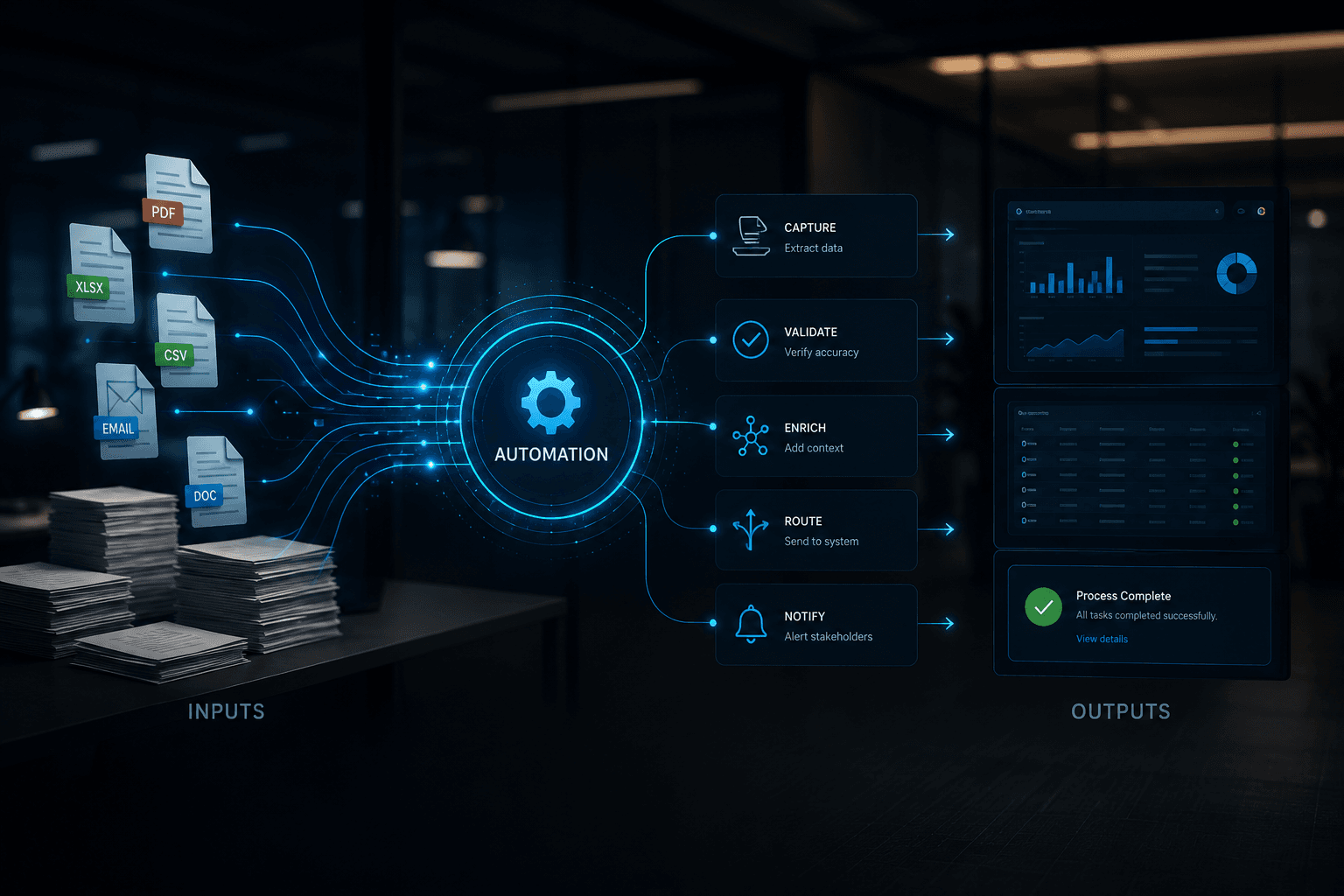
Not all workflows are created equal when it comes to AI automation. Some are too ambiguous, too high-stakes, or too judgment-heavy. Others are almost perfectly suited: repetitive, rule-based, document-heavy, and consuming far more human time than they should.
Here are five categories where we consistently see the highest return from full automation.
1. Document Intake and Classification
Organizations receive documents constantly through email, portals, and third-party systems: invoices, contracts, applications, compliance submissions. Manually classifying and routing them is high-volume and low-value.
The approach: an AI pipeline that ingests documents from any source, extracts key fields, classifies the document type, validates against business rules, and routes it to the right system or queue. Human review is triggered only for low-confidence or exception cases.
2. Standards and Compliance Comparison
Organizations under regulatory frameworks need to compare new requirements against existing policies, identify gaps, and generate summary reports. Traditionally, that's a consulting engagement or a weeks-long internal project.
The approach: a document intelligence system that ingests regulatory documents, maps requirements to internal policies, identifies gaps, and generates structured comparison reports. A multi-week process becomes a matter of hours.
3. Support Ticket Resolution for Known Issues
A significant portion of support tickets, often 30 to 50 percent, are variations of previously solved problems. Experienced agents recognize the pattern. Less experienced agents spend 15 to 30 minutes researching.
The approach: an AI support system trained on historical tickets and product documentation that resolves known-issue tickets automatically with full context logging. Novel or complex tickets are flagged for human review.
4. Approval Routing and Status Tracking
Internal approval workflows, whether expense approvals, vendor onboarding, or contract sign-offs, often involve multiple stakeholders, unclear status, and manual email chasing. Delays compound.
The approach: an orchestrated workflow that routes requests to the right stakeholders based on predefined rules, sends reminders, tracks status in real time, escalates on deadline breaches, and logs every action for auditing.
5. Data Extraction from Unstructured Sources
Many business processes depend on data locked inside PDFs, emails, or scanned documents: shipping manifests, claim forms, purchase orders. Manually extracting and entering this data is error-prone and slow.
The approach: an AI extraction pipeline that identifies document types, extracts structured data accurately, validates against master data, and writes directly to the target system, with an exception queue for edge cases.
The Common Thread
Each of these workflows has the same profile: high volume, rule-governed, document-heavy, and currently handled by people who could be doing more valuable work. That's the target zone for full automation.
The question isn't whether AI can automate them. It's whether your implementation is production-ready enough to trust it.