
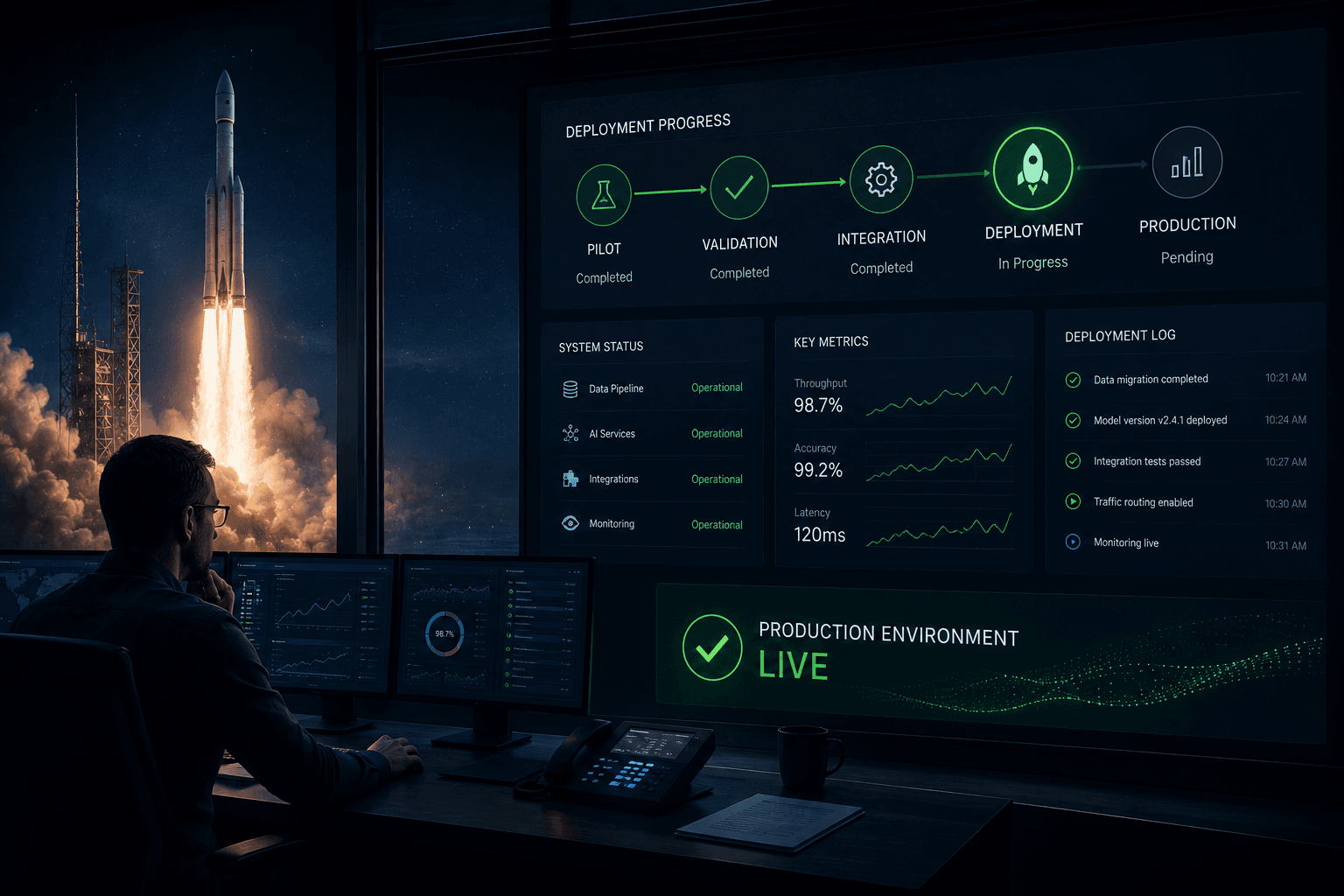
The gap between an impressive AI pilot and a production AI system is wider than most organizations expect. We've seen both: pilots that never escaped the conference room, and production systems that now handle thousands of operations per day. The difference is almost never the AI model.
It's everything else.
Why Pilots Don't Make It to Production
They're built to demonstrate, not to operate. A pilot is optimized for showing what's possible in a controlled environment. A production system is optimized for reliability, observability, and graceful degradation when things go wrong. Different goals produce different systems.
They skip the integration work. A pilot often uses mocked data or a simplified version of the real workflow. When it's time to connect with the actual CRM, the legacy document system, or an approval workflow involving seven stakeholders, the complexity multiplies fast.
They have no human oversight design. In a pilot, someone is watching every output and catching errors in real time. In production, you need explicit escalation paths, confidence thresholds, and monitoring, because no one is watching every transaction.
They don't account for edge cases at scale. A pilot runs on a curated dataset. Production systems see the full range of real-world inputs: malformed documents, ambiguous requests, missing data, adversarial inputs. The system needs to handle all of them gracefully.
The Framework We Use
Phase 1: Discovery. Before writing a line of code, we map the workflow end-to-end. Where does data come from? Where does it need to go? What are the failure modes? Who are the stakeholders? What does success actually look like in business terms?
This phase produces a workflow map, a data inventory, and a success metric framework. Without them, you're building in the dark.
Phase 2: Architecture Design. This is where the critical decisions get made: which models, what retrieval strategy, how the system integrates with existing infrastructure, what the human oversight design looks like, and how it'll be monitored.
Bad architecture decisions here are expensive to undo. We spend more time on this phase than most.
Phase 3: Pilot Build. Build the smallest version of the system that demonstrates real value on real data. Not synthetic data: actual operational inputs. This surfaces integration complexity and data quality issues early, when they're cheap to fix.
Phase 4: Production Hardening. This is the phase most organizations skip or underfund. It includes error handling and graceful degradation, confidence scoring and escalation logic, logging and observability, load testing, security review, and documentation.
Phase 5: Deploy and Iterate. Production deployment with a defined monitoring plan. Success metrics tracked weekly. A clear process for handling edge cases and model drift.
The Non-Negotiables
Every production AI system we build has human-in-the-loop checkpoints for low-confidence decisions, full audit logging for every AI action, monitoring dashboards that surface anomalies before they become incidents, and documented escalation paths that don't require the original engineer to resolve.
A pilot that impresses stakeholders is a starting point. A production system that improves operations quarter over quarter is the goal.
That's the only metric that matters.